The History of Computer Games: From the First Experiments to the Digital Age
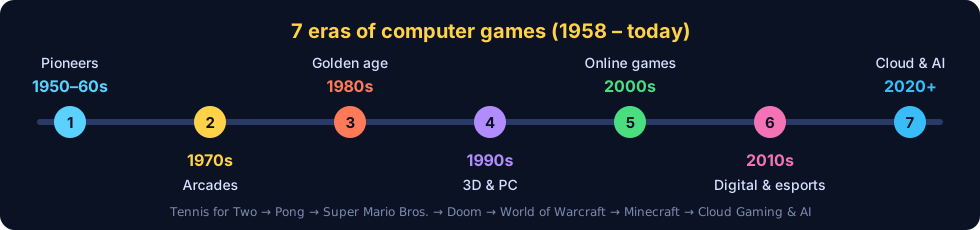
Computer games have travelled from a glowing line on an oscilloscope in 1958 to virtual worlds shared by millions of players at once. This article covers the history of computer games in seven eras – from Tennis for Two, Pong and Super Mario Bros. to Doom, World of Warcraft, Minecraft and today's age of cloud gaming and AI.
Introduction: when computers were not just for calculating
Computer games are one of the innovations that best reflect the progress of technology and human imagination. They began on room-sized computers that could only show text or very simple images, and grew into virtual worlds where players can explore, fight, build cities, play sports and live in a digital society.
The history of computer games is not only a story about entertainment. It is closely tied to the development of processors, graphics, networks, the internet, artificial intelligence and a creative industry that influences people all over the world.
1. The pioneers: the birth of computer games (1950s–1960s)
In the mid-20th century computers were huge, expensive machines used mainly for science, the military and calculation. But some researchers began to imagine using computers to create interactive activities for fun.
One of the most important early works is Tennis for Two, created in 1958 by physicist William Higinbotham. The game simulated a tennis match on an oscilloscope screen and let two players compete against each other.
In 1962, MIT students led by Steve Russell developed Spacewar! on the PDP-1 computer. Players controlled spaceships, fought each other and moved under the gravity of a star.
Spacewar! was hugely important because it showed that computers could create play experiences far more complex than simple calculation, and it inspired the next generations of game developers.
2. The arcade era: games become a business (1970–1979)
The 1970s were a turning point, as games left the laboratory and moved into public places such as arcades, shopping malls and entertainment centres.
In 1972 Atari released Pong, a table-tennis game with very simple 2D graphics. It became extremely popular and helped create the commercial arcade game market.
In 1978 Taito released Space Invaders, a shooter in which the player defends against waves of alien attackers. It started a huge craze and helped make arcade games part of popular culture.
Towards the end of the decade, games also developed alongside home consoles, so people could play without going to an arcade.
🎮 Want a taste of arcade-style space shooting in 3D? Play SPACE SHOOTER free in your browser.
3. The golden age of arcades and home consoles (1980–1989)
The 1980s were the decade when game characters gained real personalities and became famous with players around the world.
In 1980 Namco's Pac-Man became a hit thanks to its easy-to-understand gameplay: guide the character through a maze, eat the dots and avoid the ghosts.
In 1985 Nintendo released Super Mario Bros. for the NES. It raised the bar for level design, character control and the presentation of a game world, and became the key model for platform games.
At the same time personal computers spread quickly – the IBM PC, the Apple II and the Commodore 64 – giving rise to many kinds of computer games: adventure games, simulations, strategy games and role-playing games (RPGs).
Games began to develop along two paths that grew side by side: the console market and the personal computer market.
4. 3D graphics and the rise of PC games (1990–1999)
As computers became more powerful, games began a serious move from 2D images to 3D worlds.
In 1993 id Software's Doom made the first-person shooter (FPS) famous with its fast gameplay, thrilling atmosphere and early support for multiplayer over a network.
In 1994 Warcraft: Orcs & Humans helped make real-time strategy (RTS) games popular: players gather resources, build bases, train armies and plan how to defeat their opponents.
In 1996 Quake pushed 3D graphics technology and network multiplayer even further, while RPGs and simulation games kept evolving.
As the internet spread at the end of the decade, players began to connect with others far away, laying the foundation for the online gaming communities that followed.
🎮 Into FPS games? Try our browser first-person shooters DESERT STORM and SWEET BULLET – no download needed.
5. The internet and online games (2000–2009)
In the early 21st century, high-speed internet and more powerful computers clearly changed the way people played.
Games like Counter-Strike made competition between players over a network popular, while The Sims let players simulate everyday life and freely create stories for their characters.
In 2004 World of Warcraft opened a huge online world where large numbers of players could adventure together, create characters, join groups and take part in activities in the same virtual world.
Internet cafés also played an important role in many countries, including Thailand, as places where players met, practised and competed with friends.
Online games were no longer just programs installed on a computer – they became social spaces where players spent time together.
6. The digital age: games become a global platform (2010–2019)
The 2010s were a decade of rapid growth for digital game purchases, online platforms and esports.
Platforms like Steam let players buy, download, update and manage their game libraries in one place, reducing the reliance on physical discs.
Minecraft showed that fun does not have to come from fighting: players can build structures, explore the world and use their imagination freely.
Meanwhile League of Legends helped turn esports into an international activity, and battle royale games like PUBG made matches with many players on the same map widely popular.
Another big change was game streaming on video platforms. Players could broadcast matches live, share techniques and build communities of followers, creating new careers such as pro gamers, content creators and esports casters.
7. Today: cloud gaming and artificial intelligence (2020 onwards)
Today computer games go far beyond pictures and sound. Developers focus on highly detailed worlds, realistic physics and complex character behaviour.
The key technologies of this era include:
- Ray tracing: simulates light, shadows and reflections more realistically
- Cloud gaming: lets you play games that run on servers over the internet, without always needing a high-end computer
- Virtual reality (VR): lets players interact with virtual environments through dedicated devices
- Artificial intelligence (AI): helps control character behaviour, generate dialogue, support testing and improve the game development process
These technologies still have limits, however: price, hardware, internet speed, licensing and development costs.
So the industry's main direction is not only better-looking graphics, but also experiences that are easy to access, diverse, and give players more ways to take part in the game world.
A close-to-home example of "easy to access" is 3D games that start instantly in a web browser on both phones and computers – see all free Prasansoft games.
8. Computer games and their impact on society
Computer games influence society in many ways – economically, culturally, in education and in technology.
- Economy: the game industry creates jobs for programmers, designers, artists, composers, voice actors and online-systems specialists
- Education: some games train logical thinking, planning, problem solving and teamwork, and simulations are used in learning and training – for example a touch-typing tutor that turns practice into a game
- Culture: many game characters and worlds have become part of popular culture and inspire films, music, art and literature
Still, gaming should be balanced – especially in managing time, getting enough rest, staying safe online and spending sensibly on in-game purchases.
Key games in the history of computer games
| Year | Game / platform | Developer | Why it matters |
|---|---|---|---|
| 1958 | Tennis for Two | William Higinbotham | Two-player interactive game on an oscilloscope |
| 1962 | Spacewar! | Steve Russell and the MIT team | Space combat on the PDP-1, the model for later games |
| 1972 | Pong | Atari | Created the commercial arcade market |
| 1978 | Space Invaders | Taito | Made arcades part of popular culture |
| 1980 | Pac-Man | Namco | A game character known around the world |
| 1985 | Super Mario Bros. | Nintendo | The model for platform games |
| 1993 | Doom | id Software | Made FPS games popular |
| 1994 | Warcraft: Orcs & Humans | Blizzard | Popularised real-time strategy (RTS) |
| 1996 | Quake | id Software | 3D graphics and network multiplayer |
| 2004 | World of Warcraft | Blizzard | A huge online world (MMORPG) |
| 2010s | Steam, Minecraft, League of Legends, PUBG | Various developers | Digital games, esports and battle royale |
| 2020+ | Ray tracing, cloud gaming, VR, AI | The whole industry | More realistic and more accessible experiences |
Frequently asked questions (FAQ)
What was the first computer game?
One of the earliest recognised computer games is Tennis for Two (1958), created by physicist William Higinbotham and played on an oscilloscope screen. Spacewar! (1962), built at MIT on the PDP-1 computer, is regarded as the prototype that inspired later generations of game developers.
Why is Pong important in video game history?
Atari's Pong (1972) was a simple table-tennis game that became hugely popular and helped create the commercial arcade market, moving games out of research labs and into arcades and shopping malls.
When did FPS games become popular?
First-person shooters became widely popular after id Software released Doom in 1993, followed by Quake in 1996, which pushed 3D graphics and network multiplayer forward.
When did esports take off?
Competitive network play became popular in the 2000s with games like Counter-Strike, and grew into an international activity in the 2010s with games like League of Legends, while game streaming created new careers such as pro players and content creators.
What technologies shape games today?
Key technologies include ray tracing for realistic light and shadows, cloud gaming that runs games on remote servers, virtual reality (VR), and artificial intelligence (AI) that drives character behaviour and supports game development.
Conclusion: from a small dot on a screen to limitless worlds
The history of computer games shows how people combine technology with creativity – from experiments like Tennis for Two and Spacewar! to arcade games, 3D PC games, online games and virtual worlds with players from all over the world.
Every era brought innovations that changed how people play and what players expect. Games that were once just lines and dots on a screen have become digital works that combine art, music, storytelling, software engineering and social interaction.
In the future, computer games may grow into worlds that respond to players more naturally, through AI, virtual reality and online systems that connect people together.
In the end, the history of computer games is not just a history of machines or programs – it is a history of human imagination growing together with technology.
Want to build your own game or app? Start with our guide Android app development for beginners.