The History of Intel CPUs: From a 4-Bit Chip to the Heart of Modern Computers
Every time you switch on a computer, play a game or search on your phone, a central processing unit (CPU) is working behind the scenes. A CPU is the chip that reads instructions, performs calculations and decides what to do next. Over six decades, Intel has been one of the most important companies in CPU development. This article follows that journey step by step.
The beginning: three people from Fairchild
Intel was founded in 1968 in California by Robert Noyce and Gordon Moore, two engineers from Fairchild Semiconductor. Andy Grove, an engineer and manager, joined soon after and led the company for many years. In the early years Intel made memory chips. The success of those products gave the company the money and reputation it needed to enter the market for processor chips.
1971: the Intel 4004, a processor chip you could buy
Intel's CPU story became serious in 1971, when the Japanese company Busicom asked Intel to design chips for a calculator. Instead of building several chips for separate functions, a team led by Federico Faggin, Marcian Hoff and Stanley Mazor proposed a more general idea: one programmable processor chip that reads instructions from memory and carries them out.
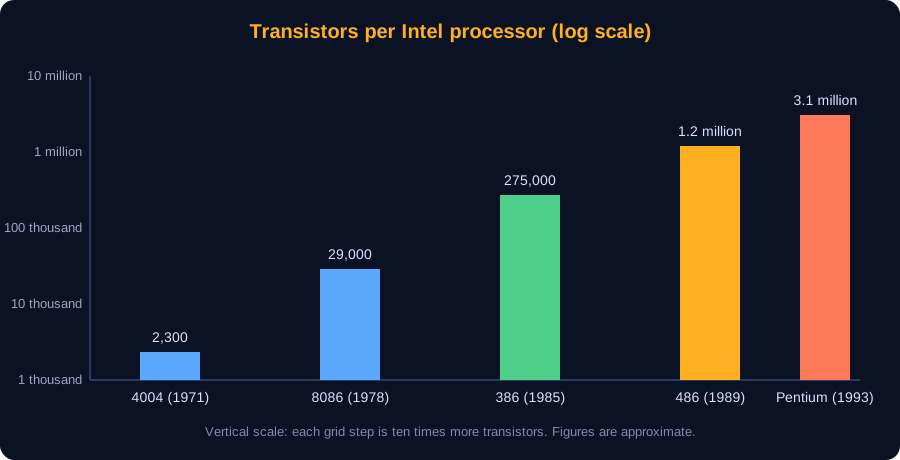
The result was the Intel 4004, a 4-bit chip with about 2,300 transistors, made with a 10-micrometre process and running at up to roughly 740 kilohertz. By today's standards it was very slow. Its importance lies in the idea: it was the first commercially sold chip that put a complete processing unit on one piece of silicon. It marked the start of the microprocessor era.
1978 to 1981: x86 and the IBM PC
The Intel 8086, released in 1978, was a 16-bit chip with about 29,000 transistors. Its design built on the instructions of earlier models, so programs could be moved to it more easily. This approach gave rise to the x86 architecture, which remained a standard for decades.
In 1981, IBM chose the Intel 8088, a version with an 8-bit external data bus, for its IBM PC. The PC became the model for a huge number of personal computers, and the software ecosystem built around x86 grew rapidly.
1985: the 386, the first 32-bit x86 chip
The Intel 386 had about 275,000 transistors. It handled multitasking efficiently and allowed operating systems such as Unix, and later Windows, to run much better. The 486 in 1989 combined a floating-point unit (FPU) and cache on one chip, which made it noticeably faster.
1993: the Pentium and "Intel Inside"
Intel named its next processor Pentium, because a number such as 586 could not be registered as a trademark. The first Pentium had about 3.1 million transistors. In 1991 Intel had started the "Intel Inside" campaign, which asked computer makers to display an Intel logo sticker. For the first time, many buyers recognised the name of the CPU inside their machine.
In 1994, the mathematician Thomas Nicely found that some division results on the Pentium were wrong. The problem became known as the FDIV bug. Intel responded slowly at first, and in the end it replaced affected chips for customers and recorded a large charge. The episode made the company place more importance on testing and on open communication with customers.
2006 to 2011: Core and Core i
In 2006 Intel introduced the Core architecture, based on its laptop processor design. It improved performance per watt considerably, and the Core 2 Duo and Core 2 Quad became popular in homes and offices. In 2008 the first Core i7 brought the memory controller onto the chip and used Hyper-Threading, which let one core run two threads at once. In 2011, Sandy Bridge added graphics to the processor, so ordinary computers could handle simple graphics tasks without a separate graphics card.
2015 to 2021: manufacturing challenges and new competition
Intel's move to a 10-nanometre manufacturing process took longer than expected. Companies such as TSMC and Samsung became leaders in some advanced chip manufacturing. Meanwhile AMD returned as a serious competitor with its Zen architecture from 2017, offering many cores at competitive prices. Intel had to change its designs, its manufacturing plans and its pricing.
In 2021, Intel answered with hybrid processors such as Alder Lake, which combine high-performance cores (P-cores) and energy-efficient cores (E-cores) on one chip. This approach accepted that raising clock speed alone was no longer enough.
Lessons from the history of Intel CPUs
- Putting the processor on one chip, which began with the 4004, changed how computers are built.
- Backward compatibility let software accumulate and grow, which is one reason x86 has lasted so long.
- Customer trust and marketing mattered almost as much as technical performance.
- When raising speed reached its limits, engineers had to find other ways to improve, such as more cores, hybrid designs and better manufacturing.
Conclusion
From the Intel 4004 with about two thousand transistors to today's processors with tens of billions, the history of Intel CPUs is a story of continuous reinvention, in architecture, manufacturing and the trust of users. Each time you turn on a computer, you are using the results of this development.